"Understanding the Difference: Right Hand Rule vs Left Hand Rule"
In the realm of physics, particularly in electromagnetism, the right-hand rule and left-hand rule serve as invaluable tools for visualizing and understanding the direction of vectors like electric field, magnetic field, and force. While both rules share a common goal, they differ in their approach and application. Let's delve into the intricacies of these rules and explore the key differences between them.
Understanding the Right-Hand Rule
The right-hand rule is a mnemonic device that helps in determining the direction of a vector in a given scenario. It's particularly useful in understanding the direction of force, torque, or current in a circuit. The rule can be stated as:
Curl the fingers of your right hand in the direction of the first vector (e.g., current, motion). Your thumb will then point in the direction of the second vector (e.g., force, torque).
Applying the Right-Hand Rule
Let's consider an example to illustrate the right-hand rule. Suppose we have a current-carrying wire placed in a magnetic field. According to the right-hand rule, if we curl our fingers from the direction of the current (first vector) to the magnetic field (second vector), our thumb will point in the direction of the force experienced by the wire.

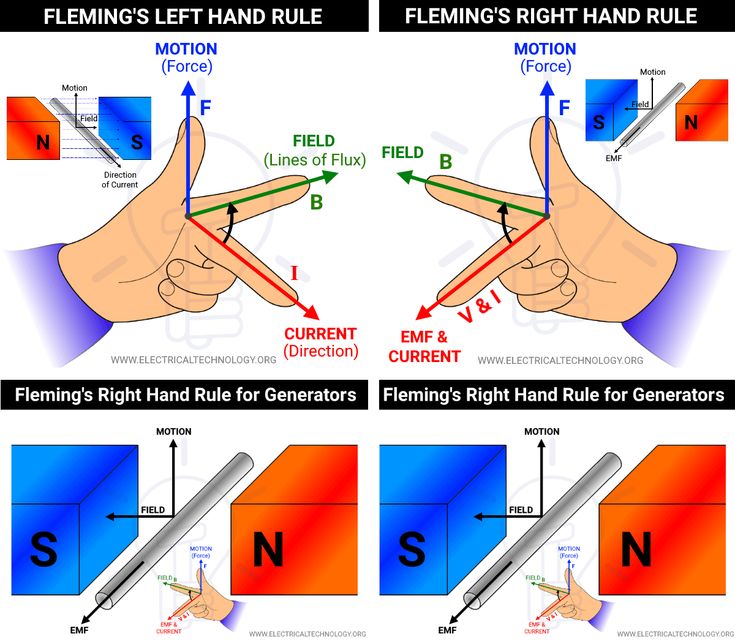

Introducing the Left-Hand Rule
The left-hand rule, on the other hand, is primarily used in understanding the direction of induced electric fields and currents. It's a useful tool in explaining Faraday's law of induction. The rule can be stated as:
Curl the fingers of your left hand in the direction of the changing magnetic field (first vector). Your thumb will then point in the direction of the induced electric field (second vector).
Applying the Left-Hand Rule
For instance, if a bar magnet is moved in and out of a coil, the left-hand rule helps us determine the direction of the induced electric field and the resulting current in the coil. By curling our left-hand fingers in the direction of the changing magnetic field, our thumb points in the direction of the induced electric field.


Differences Between the Two Rules
While both rules involve curling fingers around a vector and using the thumb's direction to determine another vector, they differ in their application and the vectors involved:
| Right-Hand Rule | Left-Hand Rule |
|---|---|
| Used to determine the direction of force, torque, or current in a given scenario. | Used to determine the direction of induced electric fields and currents. |
| Involves the direction of current, motion, or magnetic field as the first vector. | Involves the direction of the changing magnetic field as the first vector. |
| Thumb points in the direction of force, torque, or current. | Thumb points in the direction of the induced electric field or current. |
Which Rule to Use and When
Choosing between the right-hand rule and the left-hand rule depends on the specific scenario and the vectors involved:
- When dealing with forces, torques, or currents in a circuit, use the right-hand rule.
- When dealing with induced electric fields or currents due to changing magnetic fields, use the left-hand rule.
By understanding the differences between these rules and applying them correctly, you can navigate the complex world of electromagnetism with ease and clarity.


Related Articles
"When to Use Left & Right Hand Rule: Mastering Directional Physics"
The left and right hand rules are fundamental concepts in physics, particularly in understanding the direction of electric current, magnetic field, and force...
"Right Hand Rule: Understanding Force Direction"
The right-hand rule is a fundamental concept in physics, particularly in understanding the relationship between electric current, magnetic fields, and force...

"Difference Between Regular Sushi Roll & Hand Roll: A Side-by-Side Comparison"
In the vibrant world of Japanese cuisine, sushi rolls come in a delightful variety of shapes and sizes, each offering a unique dining experience. Two of the...

"Fleming's Left Hand Rule: Practice Questions & Answers"
Mastering the Fleming's Left Hand Rule is a crucial step in understanding the principles of electromagnetic induction. This rule, proposed by Sir John Fleming...

"Difference: Hand Roll vs Regular Roll"
When it comes to sushi, two of the most popular rolls are the hand roll and the regular roll. While both are delicious and unique in their own ways, they...

"Lorentz Force Law: Master the Right-Hand Rule"
The Lorentz force law, a fundamental principle in physics, describes the force acting on a charged particle moving in an electromagnetic field. Central to...